Leak Detection in March
March's water hardness from Anglian Water accelerates pinhole corrosion in copper pipes, creating slow leaks invisible until walls stain or floors rot. Properties across PE15 and PE16 postcodes often hide leaks for months because Fenland's damp climate masks the early damage. Detecting leaks early in March—before structural cost escalates—requires thermal imaging and acoustic tools calibrated for March's soil composition and mineral-heavy water supply.
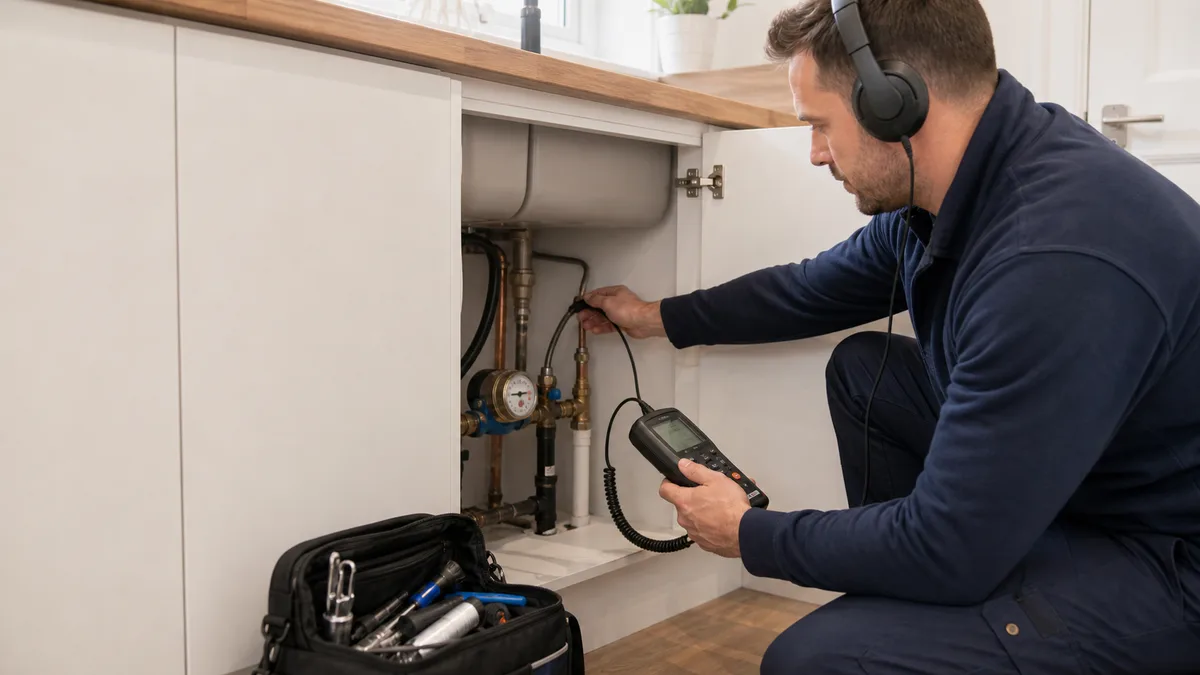
Leak detection in March uses thermal imaging and acoustic sensors to find pinhole corrosion in Anglian Water copper pipes and silent weeps in cast-iron soil stacks. Early detection in March PE15–PE18 prevents wall rot and mold in Fenland's damp climate.
Drainage in March — what local engineers know
Anglian Water's hard-water supply in March creates aggressive conditions for copper pinhole corrosion, especially in homes built 1960–1990 where copper replaced original lead pipework. Fenland Council building stock surveys show March has above-average rates of Victorian and Edwardian properties with failing cast-iron soil stacks that weep silently into external walls. The local clay soil in postcodes PE15 and PE16 retains moisture, masking internal leaks. Thermal imaging reveals temperature anomalies in March properties caused by water seeping through voids or under concrete floors—critical for distinguishing real leaks from condensation.
- Hard water supply causes limescale accumulation in boilers, radiators and soil pipe joints — powerflush and descaling demand is high across March
- Separate sewer system across most of March: misconnections (e.g. washing machines plumbed into surface water drains) are a known local issue and can result in environmental enforcement action
- Coastal salt-laden air in March accelerates corrosion of external soil stacks, pipe brackets and galvanised fittings on exposed elevations
- With 28% of properties built before 1920, salt-glazed clay drainage and lead-solder copper pipework are common — pipe collapse, root ingress and joint failure are recurring call-out drivers.
What happens when you call us in March
- 1 Immediate dispatch. We find the nearest available engineer covering PE15/PE16 and confirm the ETA before the call ends.
- 2 On-site diagnosis — no guessing. The engineer inspects using professional-grade equipment including CCTV where needed and quotes a fixed price before work starts.
- 3 Job complete, report issued. You receive a written completion report. All work is guaranteed — same fault returns within the guarantee period, we come back free.